
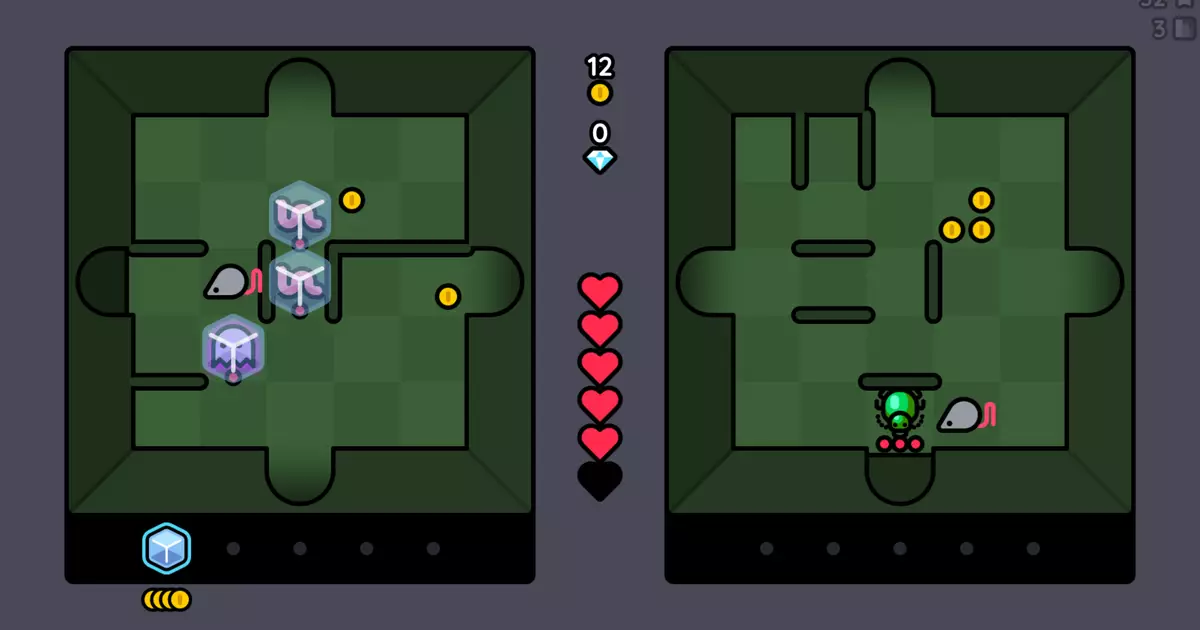
Rat King emerges as a captivating revelation in the realm of turn-based puzzle games, boldly challenging players to orchestrate two characters simultaneously within discrete yet interconnected worlds. Unlike typical single-screen puzzles, this game demands dual awareness and strategic planning, pushing players to think beyond traditional boundaries. The gripping novelty lies in controlling two rodents that traverse separate dungeon layouts, each filled with unique enemies and environmental challenges. This duality fosters a layered cognition—players must juggle the states of both characters, ensuring neither succumbs while progressing through floors. It transforms the familiar mechanic of turn-based movement into a nuanced dance of anticipation and foresight, demanding a higher level of mental agility.
Design Philosophy and the Art of Synchronization
At its core, Rat King embodies a beautiful tension: the simultaneous control of two independent entities that share a single health resource. This shared vulnerability is a brilliant touch, emphasizing cautious decision-making over reckless experimentation. The game’s room layouts, a 5×5 grid, serve as the battlegrounds for this delicate balance. Each room’s enemies and environment unfold differently for each rat, naturally creating scenarios where they fall out of sync—one cornering an enemy while the other is vulnerable elsewhere. These moments are far from frustrating; instead, they invoke a calculated urgency, compelling players to devise move sequences that maintain safety across both screens. The necessity of strategic foresight elevates Rat King from mere puzzle gameplay to an intricate mental chess match, where every move must be deliberate.
Innovative Use of Mechanics and Items
What truly sets Rat King apart is its clever utilization of items that dramatically influence gameplay. Power-ups like the ice cube freeze enemies temporarily or the spinner item that inverts control inputs for a single rat inject fresh tactical layers. These tools are not mere gimmicks—they are essential puzzle components that demand precise timing and situational awareness. Interestingly, the game’s design ensures that any advantage gained remains localized; items collected affect only the specific dungeon half, reinforcing the gameplay’s split-screen architecture. The interplay between environmental hazards, item usage, and enemy patterns creates a dynamic puzzle environment that demands adaptability and lateral thinking.
A Subtle Commentary on Trial, Error, and Punishment
Rat King’s charm also lies in its delicate balance of challenge and punishing consequences. For instance, bouncing repeatedly off surfaces to reset positions, although tempting, risks awakening vengeful ghosts—an inventive narrative device that embodies the game’s principle: reckless brute force leads to penalty. This design choice subtly discourages mindless trial-and-error, instead favoring measured movement and deliberate tactics. The ghosts themselves, silent but ominous sentinels of the game’s soft design constraints, serve as a reminder that patience and precision outweigh brute force. Such mechanics evoke a sense of mastery once a complex sequence is unraveled, rewarding persistence with a satisfying sense of accomplishment.
Potential as a Classic in the Making
Despite its apparent simplicity—control two rats, solve puzzles—the game hints at a depth that could make it a fixture among puzzle aficionados. Its resemblance to “broughlikes,” particularly Michael Brough’s 868-Hack, signals a design philosophy centered on elegant minimalism and sophisticated mechanics. Rat King, in its nascent form, suggests a legacy of puzzle games that challenge the mind and refine the player’s strategic instincts. Accessible yet profound, it glimmers with the promise of becoming a modern classic that encourages players to think differently about puzzle-solving, control, and risk management.
Rat King’s blend of innovative control schemes, environmental interaction, and tactical depth exemplifies what contemporary puzzle design can aspire to. It’s not just a game—it’s a testament to the creative potential of minimalist mechanics when paired with thoughtful strategies. For those willing to embrace its quirky challenge, Rat King offers a playground where every move feels both earned and exhilarating.
Leave a Reply