
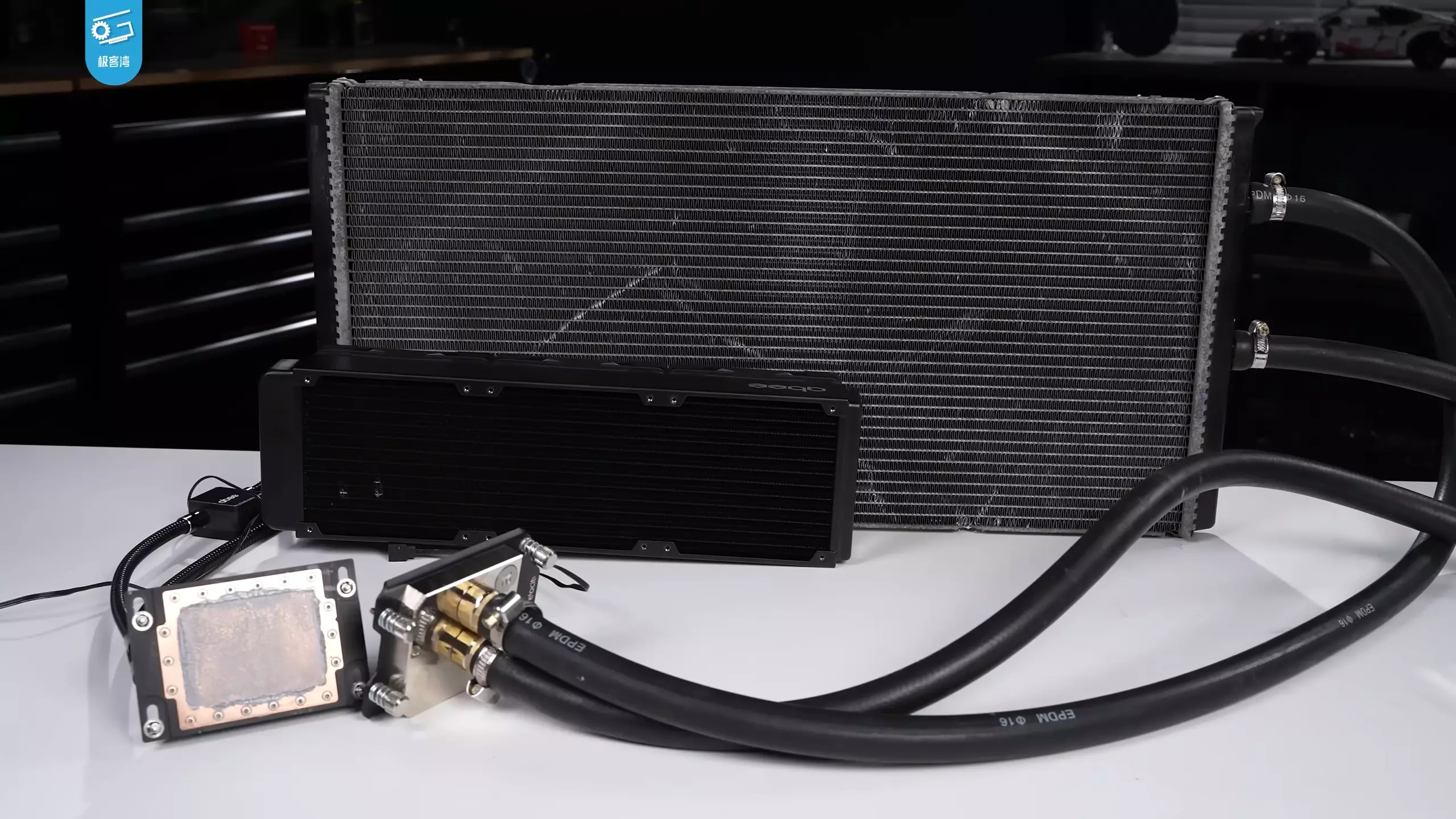
In the realm of high-performance computing, enthusiasts and experts are constantly exploring unconventional methods to push their hardware beyond standard limits. The recent experimentation by the YouTube channel Geekerwan exemplifies this relentless drive. They dared to repurpose automotive cooling components—namely a BMW M4 radiator, Toyota Highlander fans, and even a water pump—from a car to tackle the cooling demands of AMD’s formidable Ryzen Threadripper Pro 9995W CPU. While the idea might seem outlandish at first glance, it underscores a core truth: innovation often thrives at the intersection of disparate technologies. When traditional liquid cooling setups fall short of managing extraordinary thermal loads, the temptation to look outside the box— or even outside the PC industry—becomes irresistible.
This bold endeavor resulted in a groundbreaking achievement: maintaining a 96-core processor at 4.9 GHz across all cores, a feat previously constrained by conventional cooling methods. Although full overclocking with liquid nitrogen remains the gold standard in achieving world record speeds—like the 5.8 GHz mark on the same CPU—such extreme measures are impractical for everyday use. The real story here isn’t about topping charts but about testing the limits of what’s possible through creative engineering. It challenges us to think differently, even if the final solution isn’t scalable or practical for mainstream audiences.
The Practical and the Absurd: Lessons from the Automotive Cooler
Despite its ingenuity, this car radiator setup exposes significant limitations. Automotive radiators and water pumps are designed for vastly different thermal and flow characteristics compared to those needed for CPU cooling. The BMW M4 radiator, while compact for a car component, remains bulky and inefficient for dissipating the heat generated by a 1000-watt processor over sustained periods. The physical size alone introduces logistical challenges, making it less than ideal for everyday high-performance PC builds.
Furthermore, the choice of cooling fans illustrates the quirky nature of such experiments. Using twin Toyota Highlander radiator fans—originally intended for different vehicles—demonstrates a willingness to repurpose hardware in unconventional ways. These fans, consuming around 100 W just to operate, managed to move an astonishing volume of air, but their power draw underscores a crucial point: efficiency suffers when non-specialized components are repurposed outside their intended environment. It’s a reminder that while innovation is vital, practicality can never be entirely sacrificed.
The experiment also revealed the vulnerabilities inherent in such setups. The cooling system struggled to match the power demands of the overclocked CPU, leading to underutilized radiators and inconsistent thermal management. In real-world applications, such setups would be far too cumbersome, noisy, and unreliable for daily use. The complexity and risk involved—ranging from excessive power consumption to potential hardware damage—render this more of a scientific curiosity than a feasible solution.
Implications for the Future of Cooling Technology
This daring experiment isn’t merely about breaking records; it serves as a provocative commentary on the future of thermal management in high-performance computing. The industry has long relied on specialized PC cooling solutions—air coolers, water loops, phase change systems—that are finely tuned for the specific demands of CPUs and GPUs. The idea of using automotive components, which are mass-produced for entirely different thermal environments, forces us to confront the limitations of current cooling paradigms.
Could future innovations borrow more from other industries to meet escalating performance demands? Potentially. Adaptive, modular cooling systems that combine elements from various sectors might eventually become more commonplace. For example, hybrid systems that incorporate automotive radiators or industrial heat exchangers could provide scalable solutions for server farms or overclocking enthusiasts willing to experiment. However, significant advances in engineering, control systems, and safety would be necessary to transform such concepts into practical tools.
Ultimately, the Geekerwan project underscores that pushing the envelope often involves risk, creativity, and sometimes, absurdity. While cars and CPUs serve entirely different purposes, the crossover experiments highlight the importance of thinking beyond traditional boundaries. They challenge us to reimagine what is possible—not just within the narrow confines of computer hardware but across the wider landscape of engineering innovation. In this context, the real victory lies not in achieving the highest clock speeds but in inspiring a culture of relentless curiosity and daring experimentation.
Leave a Reply