
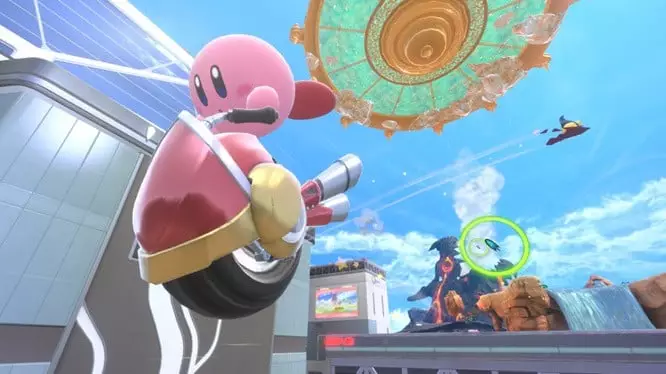
The recent revealing of Kirby Air Riders marks a pivotal moment in the realm of racing games, especially within the Nintendo universe. Unlike traditional titles that often emphasize straightforward competition and predictable mechanics, this game boldly ventures into uncharted territory by blending frenetic pace with layered complexity. It’s not merely a sequel but a reinvention that challenges preconceived notions about what a Kirby-themed racing experience can be. This game invites players to rethink speed, control, and chaos, transforming what might seem like a simple kart-racing escapade into a vivid spectacle of skill and strategy.
One significant aspect that stands out is the game’s visual dynamism. Unlike many racers that chase minimalism or stylized simplicity, Kirby Air Riders embraces an explosion of color, intensity, and sensory overload. The game doesn’t shy away from overwhelming players with vibrant effects and elaborate environmental hazards, such as violent vortexes and meteor showers, which serve both as obstacles and strategic elements. This lush visual presentation elevates the racing experience from mere competition to an immersive adventure where every lap feels like a high-stakes event.
Gameplay Depth That Surpasses Expectations
Despite Kirby’s reputation for accessible gameplay, this latest installment challenges that stereotype. Early impressions highlight how deceptively complex Air Riders really is—what appears straightforward can quickly evolve into chaos requiring quick reflexes and adaptability. The physics of controlling racing machines are intentionally loose, allowing for unpredictable swerve and drift patterns that often resemble wild rides rather than precise navigation. This could be off-putting for those seeking a traditional racing experience but is undeniably appealing for players craving unpredictability and frenetic action.
Moreover, the game’s dual modes—standard races versus the chaotic City Trial mode—offer distinct experiences that cater to different playstyles. Races at high speeds with intricate wall rides and river runs are exhilarating, emphasizing raw speed and skill, while City Trial introduces strategic chaos, with randomly generated hazards and power-ups that can turn the tide of a match in seconds. As a result, no two sessions are alike, fostering replayability and strategic experimentation. Players are encouraged not just to race but to adapt on the fly, leveraging the unique traits of different characters and vehicles.
The Future of Kirby on Switch and Its Broader Impact
Scheduled for release later this year on Switch 2, Kirby Air Riders holds the potential to redefine what players can expect from Nintendo’s flagship franchises. The game’s unique blend of high-octane racing, chaotic multiplayer modes, and intricate environmental design elevates it beyond simple spin-off fare. It signals a willingness on Nintendo’s part to push boundaries, exploring more chaotic, visually stimulating, and strategically complex gameplay.
This evolution is particularly significant considering Kirby’s traditionally accessible nature. Air Riders suggests that the franchise is maturing, willing to embrace its cult status and cater to players seeking depth and challenge. Unlike the more predictable Mario Kart formula, this title invites competition driven by chaos, experimentation, and a vibrant aesthetic. It may even inspire future Nintendo titles to innovate within familiar genres, blending visual spectacle with layered gameplay to create memorable, dynamic experiences.
By the time the game launches — with anticipation running high due to its impressive previews and gameplay footage — it seems poised to carve out a niche that balances accessibility with experimentation. Whether this will translate into widespread acclaim or polarize fans remains to be seen, but what’s undeniable is that Kirby Air Riders is set to offer a fresh, exhilarating take on racing that could invigorate the genre for years to come.
Leave a Reply