
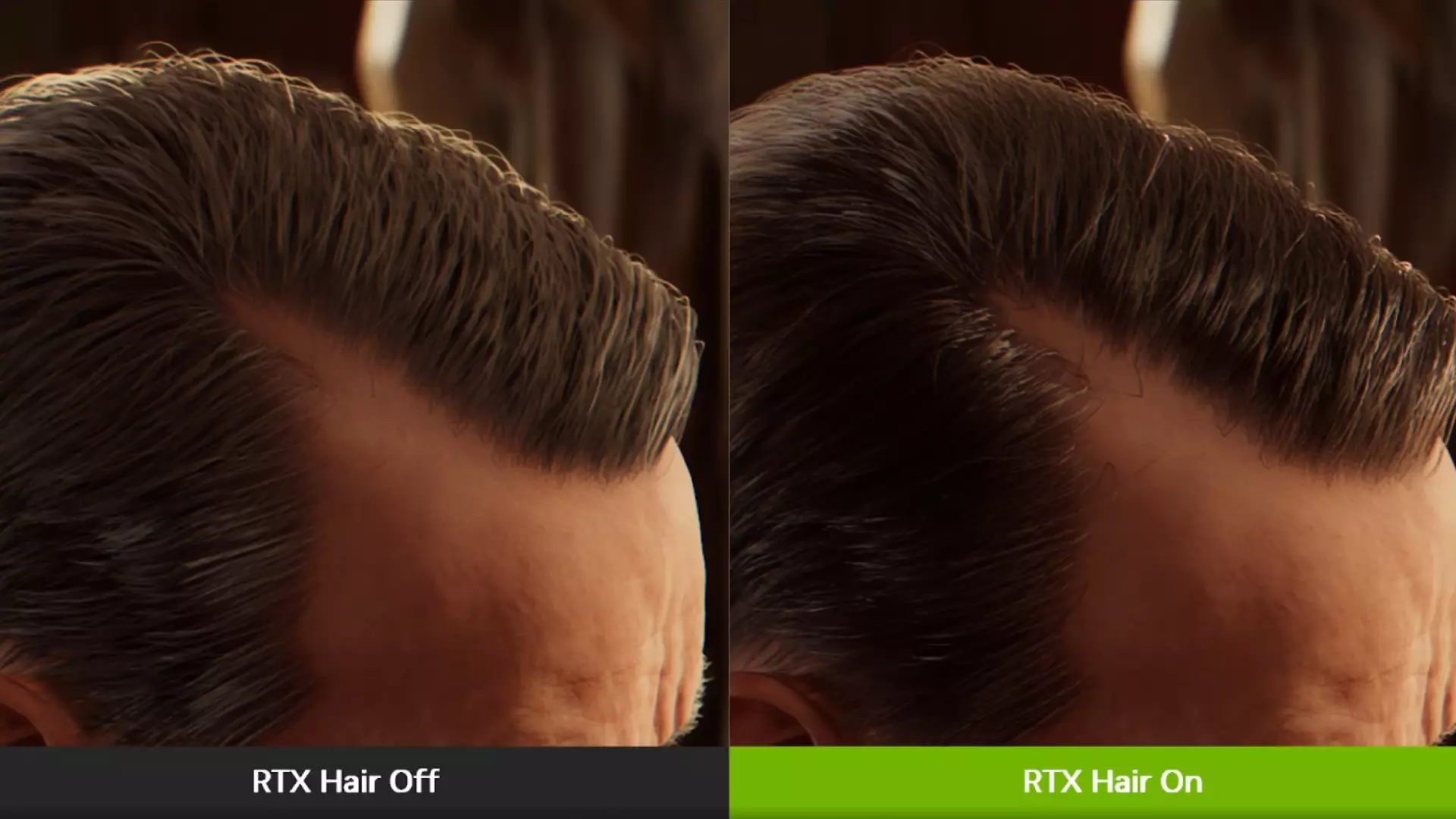
In the ever-evolving landscape of video game graphics, the pursuit of realism consistently pushes developers and hardware manufacturers to innovate. Among the most challenging aspects has always been rendering natural hair—a complex amalgamation of individual strands, textures, and movement. Traditional methods, though pioneering in their time, often fell short of delivering lifelike visuals without sacrificing performance. NVIDIA’s latest leap with RTX Hair technology promises not just incremental improvement but a seismic shift in how virtual hair is visualized, blending artistry with engineering mastery.
This new technology introduces a fundamentally different approach, leveraging the power of the RTX 50-series graphics cards to produce hair that behaves and appears with stunning authenticity. Unlike earlier attempts, which relied on heavy geometry and tessellation—methods that quickly became performance bottlenecks—RTX Hair employs a novel primitive called Linear Swept Spheres (LSS). This innovative technique allows for highly detailed yet efficient rendering of individual hair strands, ensuring that digital characters achieve a level of realism that excites both developers and audiences alike.
What makes RTX Hair profoundly impactful isn’t merely its visual fidelity but its capacity to seamlessly integrate into real-time rendering. The balance between performance and quality is a perennial challenge in game development, and here NVIDIA’s solution shines by reducing VRAM footprints and maintaining smooth frame rates. In essence, the technology promises to deliver hair that is not only visually convincing but also playable on a broad spectrum of hardware configurations—a crucial factor in the mass adoption of realistic hair rendering.
Building on a Legacy of Hair Technology
While NVIDIA’s RTX Hair is poised to redefine what’s possible in modern gaming visuals, it stands on the shoulders of past efforts—some celebrated, others briefly forgotten. Nvidia HairWorks, introduced around the time of The Witcher 3, was an ambitious predecessor that enabled flowing manes and furry creatures, contributing significantly to immersion. However, its reliance on tessellation and extensive geometry often caused detrimental performance drops, leading many to disable the feature entirely.
The limitations of HairWorks underscored the industry’s struggle with balancing visual quality and system performance. The advent of RTX Hair signifies a more sophisticated and efficient approach, one that aims to avoid the pitfalls of previous methods. By utilizing Linear Swept Spheres, NVIDIA seeks to replicate the natural dynamics and shading of hair without overwhelming hardware, opening the door to more complex hairstyles and more nuanced lighting interactions. If successful, it could mark the end of hair as a performance bottleneck and usher in an era where digital hair is as dynamic and detailed as its real-world counterpart.
This technological progress isn’t solely about aesthetics; it’s about compelling storytelling and immersive worlds. Hair is a vital aspect of character design, capable of conveying personality, age, and emotion. When rendered convincingly, it elevates the entire gaming experience, fostering deeper connections between players and virtual characters. NVIDIA’s commitment to advancing hair realism reflects an understanding that visual fidelity impacts narrative engagement and emotional authenticity.
Anticipation and Skepticism: Will RTX Hair Deliver?
History provides a cautionary perspective. Past technologies like HairWorks showed promising potential but ultimately faltered in widespread adoption due to technical limitations and performance costs. Whether RTX Hair will defy these odds remains to be seen. The industry has long been accustomed to paying a performance premium for visual perfection, but NVIDIA’s promise of improved efficiency and quality is compelling enough to generate genuine excitement.
Moreover, the implications extend beyond just character aesthetics. As lighting, shadows, and shadows interact more realistically with hair, the overall graphical cohesion improves, adding depth and richness to game worlds. This could inspire a new wave of character design, pushing artists to craft more detailed and expressive characters, confident that technology will do justice to their visions.
Yet, skepticism remains valid. Rendering technology is only as good as its implementation and adoption. If RTX Hair proves too demanding or if the promised improvements don’t materialize at scale, the industry might revert to simpler solutions or hybrid approaches. Nevertheless, this dynamic indicates a healthy cycle of innovation and critique, essential for meaningful progress.
The real question is whether this technology will truly revolutionize how we perceive and design digital characters or become another fleeting gimmick. As with any technological leap, its success hinges on integration, accessibility, and the collective willingness of developers to embrace its full potential. If NVIDIA can deliver on its promises, RTX Hair might well represent a turning point—not just for gaming but for all digital media where realism matters.
Leave a Reply