
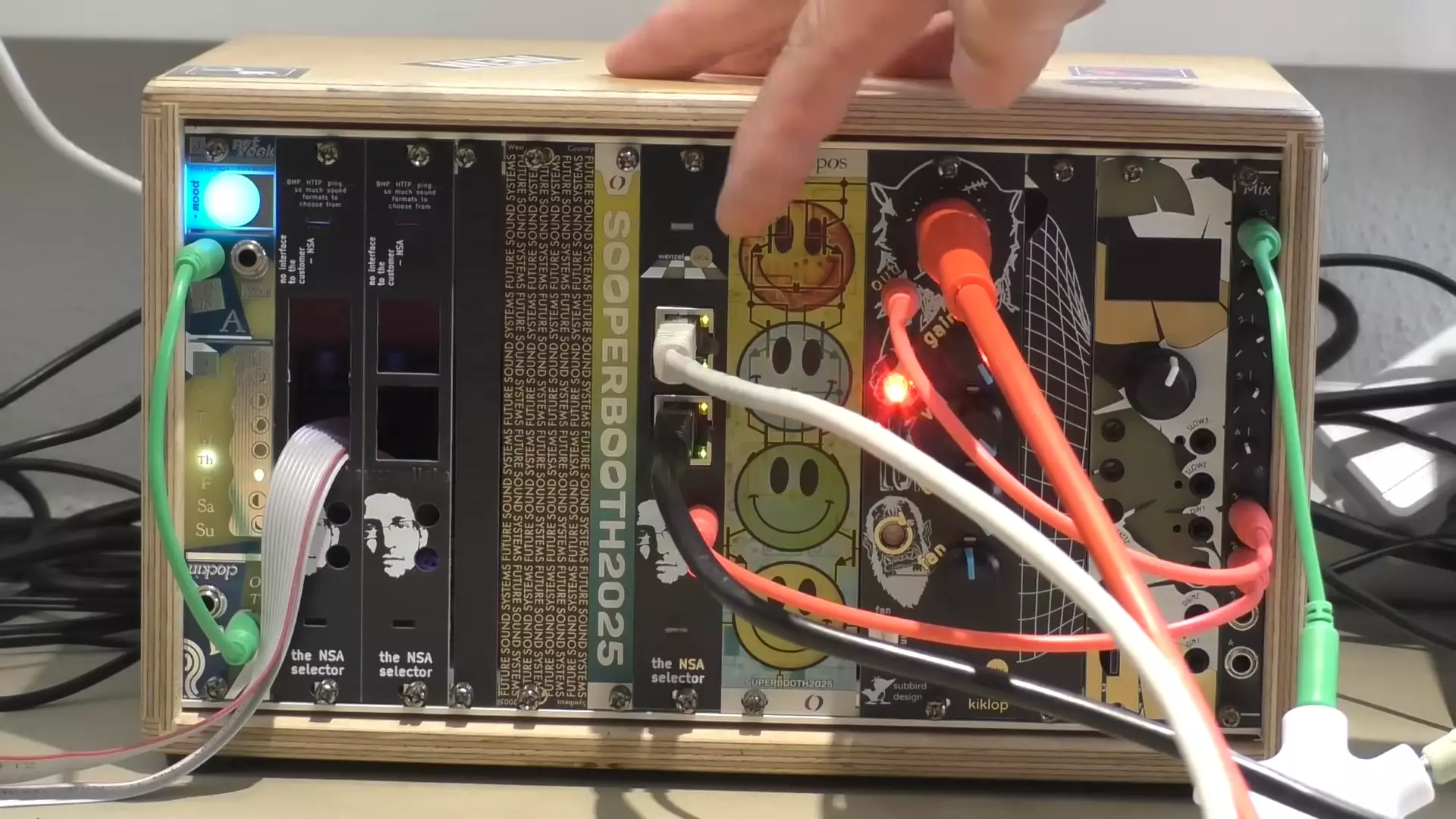
In an era where digital technology saturates every aspect of our lives, the boundary between the physical and the virtual continues to blur, leading to innovative artistic expressions. The advent of the NSA Selector, a Eurorack module that taps directly into network traffic, exemplifies this boundary-breaking approach. Unlike traditional synthesizers designed solely for musical harmony or aesthetic harmony, this device invites chaos and unpredictability into the world of sound creation. It transforms raw, unfiltered network data—bits flying across cables—into raw sonic textures that defy conventional musical sensibilities.
This concept challenges the very notion of what music is. Instead of meticulously crafted melodies and harmonies, the NSA Selector exposes the raw irregularities and randomness of our digital interactions. Each movement on a map, each load of a webpage, or every ad element loaded brings forth a disturbing yet fascinating auditory manifestation. The result is a soundscape that is as abrasive as it is intriguing, shattering notions of control and inviting chaos as an artistic medium. It’s a bold statement: that beauty in sound can emerge from the most unlikely sources—digital noise, network chatter, and data streams.
Tech as Artistic Medium: Redefining Creativity
What makes the NSA Selector truly thought-provoking is not merely its novelty but its role as a commentary on our interconnected world. It forces us to confront the noise that constantly surrounds us—be it digital advertising, data transfers, or surveillance—and repurposes it as a creative tool. In doing so, it shifts the paradigm from viewing technology as a barrier to viewing it as an extension of artistic expression.
From a broader perspective, this approach exemplifies the potential of modular synthesis in contemporary art. Synthesisers historically provided users with a palette of sounds to craft melodic compositions, but now, with devices like the NSA Selector, the palette includes chaos, randomness, and digital entropy. It asks the artist—and the listener—to embrace the unpredictable, to find aesthetic value in the disruptions and distortions generated from everyday digital traffic. Think of this as a sonification of the invisible digital chatter, transforming the unseen into the perceptible, into art.
Moreover, this device signifies a cultural statement. In a time characterized by surveillance and data commodification, repurposing network signals into sound could be interpreted as reclaiming control over our data streams. Instead of being passive consumers or targets of invisible network traffic, we are now audibly engaging with it, making the digital world more tangible and, paradoxically, more human.
The Artistic Limitations and Opportunities
Of course, embracing chaos also comes with limitations. The sounds generated by the NSA Selector are inherently abrasive, often reminiscent of industrial noise, static, and unpleasant screeches. While this may appeal to experimental musicians or noise artists, it might alienate mainstream audiences seeking melodic or harmonious music. However, that isn’t necessarily the point. This device serves as a tool for exploration—an invitation to push boundaries and redefine what sounds are worth listening to.
Creative experimentation is at the heart of this technology. Artists can manipulate images, load different resources, or even remotely control the device to generate a broad spectrum of noises. These noises, chaotic as they are, possess the potential to be shaped into textures suitable for sound art, installation art, or even live performances. The unpredictability means each session is unique, turning the process of sound creation into an active dialogue between the creator and the digital environment.
Furthermore, integrating network traffic into musical workflows can open up new form of live improvisation. Musicians could use real-time data streams—such as weather feeds, live social media metrics, or server loads—as input sources, thus making their performances inherently reactive and dynamic. This approach could usher in a new genre of interactive, data-driven music that blurs the lines between technology, art, and performance.
Reimagining the Intersection of Technology and Art
Devices like the NSA Selector are emblematic of a broader movement: leveraging technological eccentricities to challenge our perceptions of creativity. They embody an era in which the raw chaos of digital existence is no longer merely a problem to be managed, but a resource to be mined for artistic purposes. The idea that network noise can be transformed into aesthetic experience forces us to reconsider the boundaries of sonic art and even the essence of music itself.
As we continue to embed technology deeper into the fabric of artistic expression, we should embrace the chaos, the unpredictability, and ultimately, the raw authenticity of these digital disturbances. The NSA Selector reminds us that even the most disordered signals can serve as a foundation for innovation—a testament to the unending human capacity to find beauty and meaning amid disorder.
Leave a Reply