
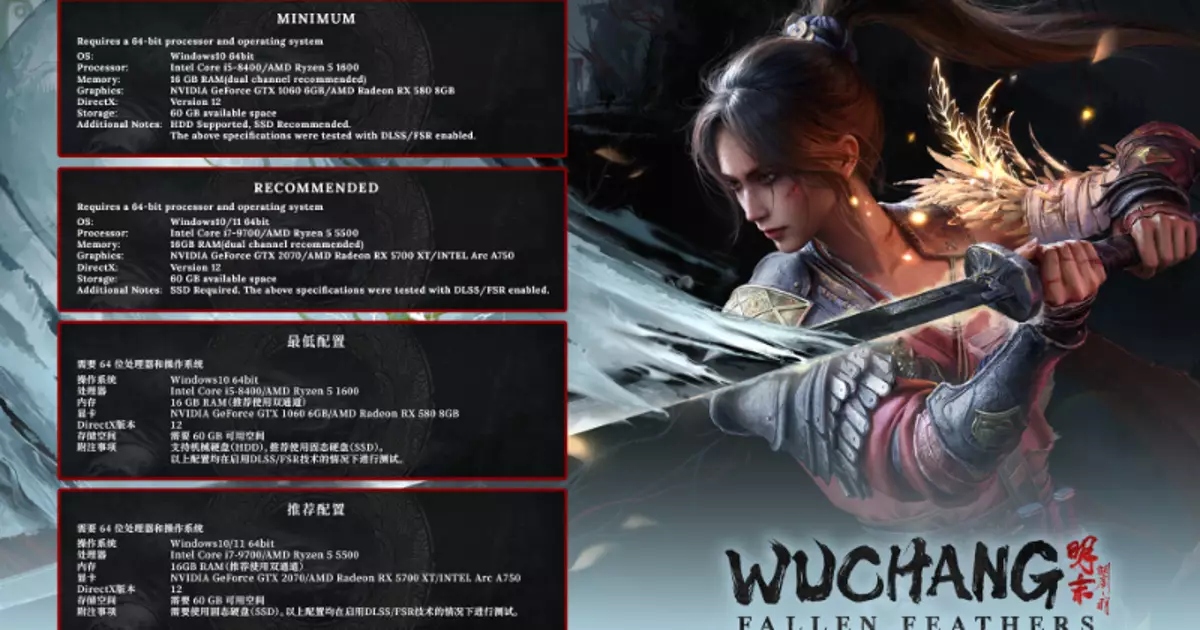
When analyzing the announced system requirements for Wuchang: Fallen Feathers, it’s clear that the developers aim for broad accessibility without sacrificing visual storytelling depth. The game’s minimum specifications—an Intel Core i5-8400, NVIDIA GTX 1060, and 16GB of RAM—are quite modest by today’s standards. This reveals an intentional design choice to reach a wider PC audience, regardless of their high-end rigs. Despite the relatively low hardware bar, players can anticipate a game rich in atmospheric detail, which has reportedly been enhanced since its 2021 previews to reduce overly redolent visuals reminiscent of Bloodborne’s Yharnam.
This balance between performance and visual quality signifies a strategic emphasis on gameplay fluidity and artistic storytelling. It suggests the developers understand that compelling worlds don’t necessarily require cutting-edge hardware—only creative ambition and efficient optimization. As someone who values the narrative potential of a game, I appreciate how a title like Wuchang proves that engaging art direction can be accessible, not exclusive to those with superpowered PCs.
Gameplay Mechanics and Player Choices Shaping Multiple Endings
Wuchang positions itself firmly within the action-RPG genre, with a dark, plague-ridden universe inspired by Chinese mythology and history. The protagonist, a mysterious amnesiac pirate swordswoman, navigates a grim setting overrun by feathered, mutant creatures—a metaphorical twist on the traditional plague narrative. The inclusion of systems such as “Red Mercury” to unlock new techniques and weapon enchantments underscores the game’s emphasis on personalized gameplay.
Crucially, your decisions influence the winding path toward multiple endings. This design fosters replayability, encouraging players to explore different storylines based on trust, secrets uncovered, and allies chosen. The narrative depth promises more than simple hack-and-slash; it aims for a richly layered experience where moral ambiguity and choice matter significantly.
From this, it’s evident that Wuchang is aligning with modern RPG trends—storytelling that’s dynamically responsive to player agency. As someone who values meaningful decision-making, I believe this approach enhances emotional investment and transforms a game from a static experience into an evolving personal journey.
Hardware: A Gateway or a Barrier?
While the minimum specs seem approachable, the recommended requirements push towards more powerful hardware—an Intel Core i7-9700 or Ryzen 5 5500, along with an RTX 2070 or RX 5700 XT. These specifications highlight the game’s potential for higher visual fidelity and smoother performance, especially with advanced features like DLSS 4 from Nvidia.
DLSS (Deep Learning Super Sampling) is a cutting-edge technology that upscales lower resolution images to higher resolutions with minimal impact on performance. For players, this means they can enjoy enhanced visual effects even on less powerful systems, provided they have the backed hardware. However, the requirement for SSD storage underscores a trend in gaming where loading speeds and seamless experiences depend heavily on faster storage solutions.
I find this dichotomy intriguing—a game designed to be approachable yet offering high-end graphical options. It embodies a philosophy where technological advancements fuel both accessibility and visual grandeur. As someone who advocates for wider gaming participation, I see this as an encouraging sign that high-quality experiences need not be confined only to the most elite systems.
What the Choice of Hardware Says About Modern Game Design
The emphasis on advanced GPU features like DLSS 4 reveals a balancing act in contemporary titles: striving for stunning visuals without alienating players who lack top-tier hardware. Yet, it inevitably raises questions about exclusive features—how many players will miss out on the full aesthetic glory simply because their systems can’t handle the latest Nvidia technology?
This divide invites reflection on how game developers approach hardware requirements—should they cater to the lowest common denominator or push the boundaries with premium capabilities? Wuchang’s tiered specs suggest a thoughtful compromise, offering enough for most gamers to enjoy an atmospheric, stylish world while providing optional enhancements for the technically equipped.
Furthermore, the game’s setting—a plague-ridden, feathered realm inspired by Chinese history—problematizes the notion of visual realism versus artistic interpretation. The developers’ effort to refine aesthetics indicates a belief that mood and atmosphere can be achieved through stylization and clever optimization, rather than brute-force rendering power alone.
Final Thoughts: A Renaissance in Accessible Yet Ambitious Gaming
Wuchang: Fallen Feathers exemplifies the evolving landscape of PC gaming, where developer priorities are shifting toward inclusivity without sacrificing artistic and mechanical depth. Its system requirements reflect a strategic attempt to make a visually compelling, narratively rich game accessible to a broad audience, yet still able to showcase cutting-edge technology for those with high-end hardware.
This approach encourages players to reflect on their gaming setups—do they settle for subpar visuals or invest in more powerful gear? Or can they enjoy a beautiful, story-driven experience regardless? Wuchang’s design philosophy invites us to consider that innovation does not always mean exclusivity; instead, it can mean democratizing the extraordinary, one feathered battle at a time.
Leave a Reply