
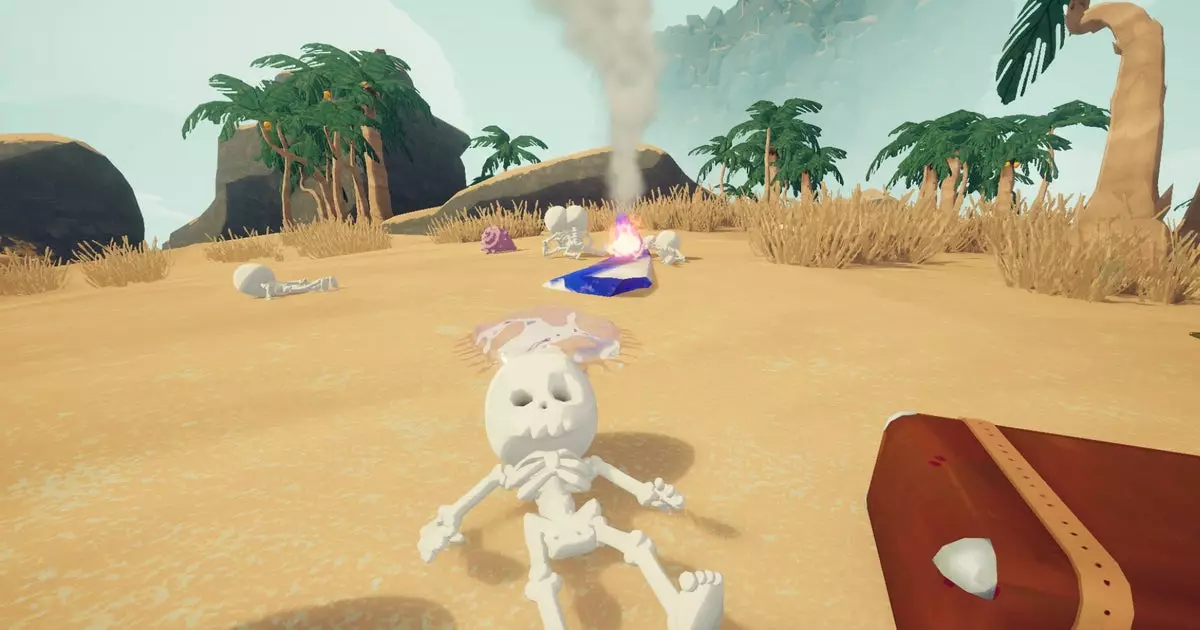
In the realm of cooperative climbing games like “Peak,” the thrill of conquering towering mountains is often accompanied by a sense of awe and personal achievement. Yet, traditional gameplay rarely taps into the more visceral human emotions related to mortality and shared vulnerability. An inventive mod, simply titled “Everest,” breaks this mold by injecting a dark, communal layer into the experience—namely, a landscape littered with the skeletons of fallen players. This bold addition challenges players to confront death not as an endpoint but as a shared part of the journey, transforming the game from solitary achievement to a collective memento mori.
This mod does more than merely populate the environment with bones; it reframes the game’s narrative geometry. Each skeleton marks a moment of failure, a badge of perseverance, and a brutal reminder of the risks involved in ascension. Unlike the usual meditative or triumphant atmosphere of mountain climbing games, Everest introduces a morbidly playful layer—an eerie tapestry woven from the casualties of fellow adventurers. With over 10,000 skeletons from thousands of players reported in the initial days, the game becomes a dynamic, living memorial, fostering a sense of community that is both macabre and compelling.
Community as a Living Mosaic of Failure and Connection
One of the most profound aspects of this mod is its ability to forge subtle but meaningful bonds among players. When users explore maps sprinkled with bones from different individuals, they instinctively recognize fellow travelers who once shared their ambitions—and their downfall. This shared corporeal footprint serves as a silent communication channel, creating a connective tissue among a dispersed community of explorers. Players begin to see themselves not just as isolated climbers but as parts of a collective story—each skeleton a chapter, each death a shared experience.
Furthermore, the manual control over the mod’s settings—via a detailed configuration file—empowers players to customize the morbid landscape. Whether they want a sparse scattering of skeletons to serve as ominous warnings or a deluge that overwhelms the environment to evoke dread, the customization fosters a deeper engagement with the game’s emotional landscape. Notifications alert players when the mod is active, ensuring that their experience is both immersive and aware, rather than chaotic or accidental.
This social dimension of shared mortality adds layers of depth to gameplay. It transforms an individual challenge into a communal spectacle, emphasizing courage and resilience in the face of collective failure. It becomes a conversation about the risks inherent in pursuit of greatness and the importance of acknowledging the community that shares the journey—dead and alive alike.
Technological Innovation Meets Cultural Reflection
From a technical perspective, Everest demonstrates how modding communities harness creativity to subvert and expand game narratives. Requiring frameworks like BepInEx and UniTask, this mod exemplifies how developers and players push the boundaries of game design to explore darker themes with humor and poignancy. Its implementation underscores the power of technology to facilitate cultural commentary—embedding mortality, community, and shared experience into the fabric of a game traditionally focused on physical challenge.
Beyond its technical aspects, the mod raises thought-provoking questions. Why shy away from confronting death directly within a gaming context? What does it say about human nature that many find the idea of a mountain of skeletons both disturbing and oddly compelling? Everest doesn’t shy from these questions; instead, it invites players to reimagine their adventure as not merely a solo quest but as part of an ongoing collective narrative about perseverance, fragility, and mortality.
The playful yet somber tone of this mod challenges players to reconsider their relationship with failure. It suggests that, in the game’s world, death is not an end but an integral part of the adventure—something to be acknowledged, even embraced. It’s a reminder that in life, as in game, the journey is often defined by the obstacles we face and the community we build along the way. Everest offers a stark but powerful metaphor for the human condition, urging us to confront our mortality with humor, camaraderie, and resilience.
Leave a Reply